
To brew pour-over coffee, use 55-60 grams of coffee per litre of water with a grind size resembling coarse table salt. Heat water between 195°F and 205°F (90°C and 96°C), adjusting for roast level. Allow a 30-second bloom before pouring. This process takes about 5 minutes and ensures optimal extraction, preventing bitterness or weakness in flavour.
What You'll Need
- Pour-Over Brewer
- This is the main device used to brew coffee, allowing for precise control over the pouring process.
- Coffee Grinder
- A grinder is essential for achieving the right grind size, which affects the extraction and flavour of the coffee.
- Coffee Beans
- Freshly roasted coffee beans are crucial for optimal flavour; aim for a medium roast for a balanced taste.
- Kettle
- A kettle, preferably with a gooseneck spout, provides control over the water flow and temperature.
- Scale
- A digital scale helps measure coffee and water accurately, ensuring consistency in each brew.
- Timer
- A timer is necessary to track brewing time, which influences the extraction process and final taste.
Step-by-Step Guide to Brewing Pour Over Coffee
- Step 1: Gather Essential Equipment
Collect all necessary tools: a pour-over brewer, a kettle, a coffee scale, a grinder, and a timer. Ensure that your kettle can maintain precise temperature control, as this is crucial for optimal brewing.
- Step 2: Choose the Right Coffee Beans
Select high-quality coffee beans, ideally freshly roasted within the last two weeks. For best results, consider the roast level; lighter roasts generally need a higher brewing temperature around 205°F (96°C), while darker roasts are better brewed at about 190°F (88°C)[1].
- Step 3: Measure Coffee and Water
Use the SCA Golden Ratio, which suggests about 55-60 grams of coffee per litre of water, translating to a ratio of 1:16 to 1:18[2]. Weigh the coffee and water accurately using a scale to ensure consistency.
- Step 4: Adjust Grind Size
- Step 5: Heat Water to Optimal Temperature
- Step 6: Bloom the Coffee Grounds
Pour a small amount of hot water over the coffee grounds to saturate them and allow them to bloom for about 30 seconds[7]. This step releases CO2 and prepares the grounds for even extraction during the main brewing.
- Step 7: Brew the Coffee
Slowly pour the remaining hot water over the coffee in a circular motion, ensuring even saturation. Aim to complete the pour within 2-3 minutes for optimal extraction[8]. Observe the flow rate; it should be steady but not too fast.
- Step 8: Evaluate the Brew
Once brewed, taste the coffee and note its flavour profile. Check for balance between acidity, sweetness, and bitterness. Adjust future brews by tweaking the grind size, water temperature, or coffee-to-water ratio based on your observations.
- Step 9: Clean Your Equipment
After brewing, clean all equipment thoroughly to prevent oil and residue build-up. Regular maintenance of your tools will ensure consistent flavour in future brews.
Essential Equipment for Pour Over Coffee
To successfully brew pour-over coffee, several essential tools are required to ensure precision and consistency. Each piece of equipment plays a vital role in the brewing process.
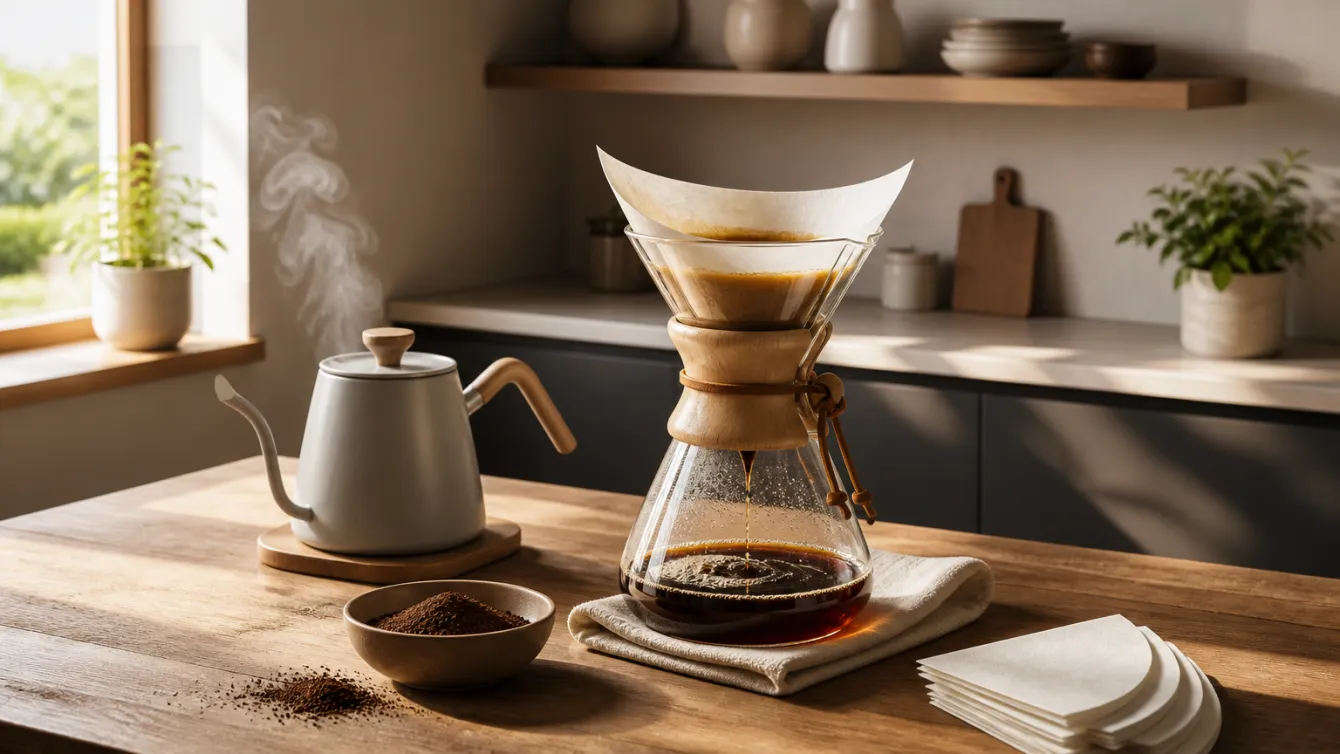
A pour-over brewer is the primary device used. It allows for manual control over the water flow, which can significantly affect extraction and flavour. Popular models include the Hario V60 and Chemex, both known for their design and effectiveness.
A coffee grinder is crucial for achieving the correct grind size, which impacts extraction. The ideal grind for pour-over coffee should resemble coarse table salt, avoiding both fine and chunky textures[3]. A bimodal grind, which combines different particle sizes, can enhance flavour[4]. Brands like Baratza and Breville offer reliable grinders suitable for home use.
A gooseneck kettle is recommended for its ability to control water flow and temperature. The optimal brewing temperature is between 195°F and 205°F (90°C and 96°C)[5]. Adjusting the temperature based on the roast level—205°F for light roasts and around 190°F for dark roasts—can further improve extraction[1][6]. Brands such as Bonavita and Fellow provide excellent options.
A digital scale is essential for measuring coffee and water accurately. The Specialty Coffee Association's Golden Ratio suggests using approximately 55-60 grams of coffee per litre of water, translating to a ratio of 1:16 to 1:18[2]. Consistency in measurements is key to achieving the desired flavour profile.
While these tools are fundamental, common problems can arise if the equipment is not used correctly. For instance, using the wrong grind size can lead to over-extraction, resulting in bitterness, or under-extraction, leading to weak coffee[9]. Ensuring that each piece of equipment is of good quality and used properly will enhance the brewing experience and the final taste of the coffee.
Choosing the Right Coffee Beans
Selecting the appropriate coffee beans is crucial for a successful pour-over experience. Arabica and Robusta are the two primary types of coffee beans. Arabica beans are generally preferred for their smoother, more complex flavours, while Robusta beans tend to have a stronger, more bitter taste and higher caffeine content. For pour-over brewing, Arabica beans are often the better choice due to their nuanced flavour profiles.
Freshness plays a significant role in the quality of brewed coffee. Ideally, coffee beans should be used within two weeks of roasting to capture their optimal flavours. As beans age, they lose their aromatic compounds, resulting in a duller taste. When purchasing, look for roast dates and choose beans that have been roasted recently.
Roast levels also impact the brewing process. Light roasts are best brewed at higher temperatures, around 205°F (96°C), to extract their delicate flavours effectively. In contrast, darker roasts should be brewed at slightly lower temperatures, approximately 190°F (88°C), to avoid over-extraction and bitterness[1]. Adjusting the brewing temperature based on roast level can enhance extraction and overall taste[6].
When brewing pour-over coffee, the grind size is another important factor. A grind resembling coarse table salt is ideal; using a grind that is too fine may lead to over-extraction and bitterness, while a grind that is too coarse can result in weak, under-extracted coffee[9]. A bimodal grind, which incorporates both fine and coarse particles, has been shown to produce richer flavours and better extraction[4].
In summary, focus on using high-quality, freshly roasted Arabica beans, adjust the brewing temperature according to the roast level, and ensure the grind size is correct to achieve the best pour-over coffee.
Grind Size and Its Impact on Flavor
Grind size is a critical factor in the pour-over brewing process, influencing extraction and flavour. A grind that is too fine can lead to over-extraction, resulting in bitterness, while a grind that is too coarse may produce weak, under-extracted coffee[9]. The ideal grind for pour-over coffee should feel like coarse table salt, providing a balance that promotes optimal extraction without compromising taste[3].
A visual guide for grind sizes can be beneficial. For pour-over brewing, the grind should fall within a range that allows for even saturation during the brewing process. A bimodal grind, which incorporates both fine and coarse particles, has been shown to enhance flavour and extraction efficiency compared to a homogeneous fine grind[4]. This approach allows for a richer flavour profile, making it a preferred choice for coffee enthusiasts.
Different drippers may require slight adjustments in grind size. For example, using a Hario V60 may necessitate a finer grind compared to a Chemex, which typically benefits from a coarser grind. Experimenting within the recommended range can help identify the best grind size for specific equipment. If the coffee tastes overly bitter or weak, adjustments to the grind size should be made accordingly.
Common mistakes include not adjusting the grind size based on the coffee type or roast level. Lighter roasts often require a finer grind to extract their delicate flavours effectively, while darker roasts may be better suited to a coarser grind[1]. Regularly assessing the flavour profile and making incremental changes to the grind size can lead to improved results in each brew.
Step-by-Step Brewing Process
The brewing process for pour-over coffee involves several critical phases that can significantly impact flavour and extraction. The first phase is heating water to the optimal temperature, which should be between 195°F and 205°F (90°C and 96°C)[5]. This range maximises extraction, with lighter roasts benefiting from the higher end and darker roasts from the lower end[1].
Timing is essential throughout the brewing process. The bloom phase, where a small amount of hot water is poured over the coffee grounds, should last for about 30 seconds[7]. This step allows carbon dioxide to escape, preventing bitterness and ensuring even extraction during the main brewing phase. Skipping this phase can lead to undesirable flavours[10].
During the main brewing stage, the remaining water should be poured slowly in a circular motion. Aim to complete this pour within 2-3 minutes[8]. A steady flow rate is crucial; if the water drains too quickly, under-extraction may occur, resulting in weak coffee. Conversely, if it drains too slowly, over-extraction can lead to bitterness[9].
In cases where the coffee tastes off, consider adjusting the grind size, water temperature, or coffee-to-water ratio. For instance, if the coffee is bitter, the grind may be too fine; if it lacks strength, the grind might be too coarse[9]. Regularly tasting and adjusting based on these observations can help refine the brewing technique.
Finally, ensure that all equipment is cleaned thoroughly after each use to maintain the quality of future brews. Regular maintenance prevents the build-up of oils and residues that can adversely affect flavour.
Common Mistakes to Avoid
Several common errors can hinder the pour-over coffee brewing process, impacting flavour and extraction. Recognising these mistakes and knowing how to rectify them can enhance the overall experience.
One frequent issue is using the incorrect grind size. A grind that is too fine can lead to over-extraction, resulting in a bitter taste, while a grind that is too coarse may produce weak, under-extracted coffee[9]. The ideal grind should feel like coarse table salt between your fingers, avoiding both powdery and chunky textures[3]. To fix this, adjust the grind size based on taste; if the coffee is bitter, try a coarser grind, and if it’s weak, go finer.
Water temperature is another critical factor. The optimal brewing temperature for pour-over coffee should be between 195°F and 205°F (90°C and 96°C)[5]. If the water is too hot, it can extract undesirable flavours, while water that is too cool may result in under-extraction. For lighter roasts, use temperatures closer to 205°F (96°C), whereas darker roasts should be brewed at around 190°F (88°C)[1]. Always check the temperature with a thermometer to ensure accuracy.
Another common mistake is skipping the bloom phase, which should last about 30 seconds[7]. This step allows carbon dioxide to escape, ensuring even extraction. Neglecting this phase can lead to undesirable flavours, so always include it in your brewing routine.
Finally, adhering to the correct coffee-to-water ratio is vital. The Specialty Coffee Association recommends a ratio of approximately 55-60 grams of coffee per litre of water, translating to about 1:16 to 1:18[2]. Adjusting this ratio based on personal preference can help achieve the desired strength and flavour.
By addressing these common mistakes, coffee enthusiasts can significantly improve their pour-over brewing technique and enjoy a better cup of coffee.
Tasting Notes and Flavor Profiles
Identifying flavour notes in coffee requires attention to various factors, including the type of beans, roast level, and brewing variables. Different coffee beans exhibit distinct tasting notes; for example, Ethiopian beans often have fruity and floral notes, while Brazilian beans may present nutty and chocolatey flavours. Understanding these profiles can enhance the tasting experience and guide coffee pairings.
When pairing coffee with food, consider the flavour intensity and characteristics. Light roasts, with their vibrant acidity and fruity notes, pair well with breakfast pastries or fresh fruits. Dark roasts, known for their rich, bold flavours, complement chocolate desserts or grilled meats. Experimenting with different combinations can lead to delightful discoveries.
Brewing variables significantly affect the taste of pour-over coffee. The grind size is crucial; too fine a grind can lead to over-extraction, resulting in bitterness, while too coarse a grind may produce weak coffee[9]. The ideal grind should resemble coarse table salt[3]. Adjusting the grind size based on the roast level can improve extraction; lighter roasts often benefit from a finer grind[1].
Water temperature also plays a vital role in flavour extraction. The optimal temperature for brewing is between 195°F and 205°F (90°C and 96°C)[5]. For light roasts, a higher temperature closer to 205°F (96°C) is recommended, while darker roasts should be brewed at around 190°F (88°C)[6]. Monitoring temperature ensures the extraction of desirable flavours while avoiding bitterness.
The coffee-to-water ratio further influences the flavour profile. The Specialty Coffee Association suggests a ratio of approximately 55-60 grams of coffee per litre of water, translating to 1:16 to 1:18[2]. Adjusting this ratio can help achieve the desired strength and taste.
In summary, paying attention to flavour notes, experimenting with pairings, and adjusting brewing variables can significantly enhance the pour-over coffee experience. Regular tasting and adjustments will refine personal preferences and elevate the brewing process.
Advanced Techniques for Pour Over Coffee
Pulse pouring and ratio adjustments can significantly enhance flavour extraction in pour-over coffee. Pulse pouring involves applying water in short bursts rather than a continuous stream. This technique allows for optimal saturation of coffee grounds, promoting even extraction. It is particularly useful when brewing with lighter roasts, which may require more precise control to avoid over-extraction. A pulse pour can also help manage the flow rate, ensuring that water does not drain too quickly or too slowly, both of which can affect taste.
Adjusting the coffee-to-water ratio is another effective method for refining flavour. The Specialty Coffee Association recommends a ratio of approximately 55-60 grams of coffee per litre of water, translating to about 1:16 to 1:18[2]. Experimenting within this range allows for personalised flavour profiles. For instance, increasing the coffee quantity can enhance richness, while reducing it may result in a lighter brew.
Common mistakes include using an incorrect grind size or neglecting the bloom phase. A grind that is too fine can lead to over-extraction, resulting in bitterness, while a grind that is too coarse may produce weak coffee[9]. The ideal grind should resemble coarse table salt[3]. Additionally, a bloom time of around 30 seconds is recommended to allow CO2 to escape, preventing undesirable flavours[7]. Skipping this step can negatively impact the extraction process.
In cases where the coffee does not meet expectations, consider assessing both the grind size and the brewing temperature. For lighter roasts, a brewing temperature closer to 205°F (96°C) is advisable, while dark roasts should be brewed at around 190°F (88°C)[1]. Regularly adjusting these variables based on taste preferences can lead to improved results.
Maintenance and Care for Your Equipment
Proper maintenance of pour-over coffee equipment is essential for optimal performance and flavour extraction. Regular cleaning of drippers and grinders can prevent the build-up of oils and residues that may compromise the taste of your brews.
For drippers, such as the Hario V60 or Chemex, rinse with hot water after each use to remove coffee oils. A deeper clean can be performed weekly using a mixture of water and mild detergent. Avoid abrasive materials that can scratch the surface. For stubborn stains, soaking the dripper in a vinegar solution can help break down residue.
Grinders require particular attention, as coffee oils can accumulate and affect grind consistency. Clean the grinder's burrs every few weeks by running a small amount of uncooked rice through it, which absorbs oils and particles. Ensure to consult the manufacturer's instructions for specific cleaning recommendations. Regularly calibrating the grind size is also important, as this can impact extraction efficiency and flavour.
The importance of maintenance cannot be overstated. Regularly cleaned equipment ensures consistent brewing results and prevents off-flavours that can arise from stale coffee oils. If coffee begins to taste bitter or off, it may be time for a thorough clean of both the dripper and grinder.
In summary, maintaining your pour-over equipment through regular cleaning and calibration is crucial for achieving the best possible coffee. By following these practices, coffee enthusiasts can enjoy rich, flavourful brews while prolonging the life of their equipment.
What to Do If It Didn't Work Out
Coffee Tastes Bitter
If the coffee is overly bitter, the grind size is likely too fine, leading to over-extraction. Adjust the grinder to a coarser setting and taste the coffee again. Experimenting with the grind size can significantly alter the flavour profile and enhance the overall experience.
Coffee Lacks Strength
Weak coffee often results from an overly coarse grind or insufficient coffee-to-water ratio. Ensure the grind resembles coarse table salt and adjust the ratio to about 55-60 grams of coffee per litre of water[2]. This adjustment can help achieve the desired strength and richness in flavour.
Uneven Extraction
Uneven extraction can occur if water is poured too quickly or not evenly distributed over the coffee grounds. To rectify this, practice a slow, circular pouring technique during the main brewing phase. Maintaining a steady flow over the grounds allows for even saturation and extraction.
Coffee is Too Sour
Sour coffee typically indicates under-extraction, often due to water that is not hot enough or an insufficient brew time. Ensure the water temperature is between 195°F and 205°F (90°C and 96°C)[5] and allow the bloom phase to complete before pouring the remaining water. Adjusting these factors can improve flavour balance.
Bloom Phase is Skipped
Neglecting the bloom phase can lead to undesirable flavours and poor extraction. Always allow the coffee to bloom for about 30 seconds before the main pour[7]. This step enables carbon dioxide to escape, ensuring more uniform extraction and enhancing the final taste.
Inconsistent Brew Quality
Inconsistency in brew quality may arise from unclean equipment or irregular maintenance. Regularly clean the dripper and grinder to prevent the build-up of oils and residues. Following a consistent cleaning schedule will help maintain the integrity of flavours in every brew.
FAQ
- How do I make pour-over coffee as a beginner?
Start by gathering your equipment: a pour-over dripper, filter, kettle, and scale. Measure out your coffee and water, aiming for a ratio of 55-60 grams of coffee per litre of water[2]. Heat the water to between 195°F and 205°F (90°C and 96°C)[5], place the filter in the dripper, and rinse it with hot water. Add the coffee grounds, pour a small amount of water to bloom for about 30 seconds[7], then continue pouring in a slow, circular motion.
- Is pour over really better than drip?
Pour-over coffee often allows for more control over variables like water temperature and flow rate, leading to a more tailored flavour profile. While drip coffee makers can be convenient, pour-over methods typically result in a cleaner cup with enhanced flavour clarity due to the manual brewing process.
- How much coffee do you use for a pour over coffee?
The recommended coffee-to-water ratio for pour-over coffee is approximately 55-60 grams of coffee per litre of water, which translates to about 1:16 to 1:18[2]. Adjust this ratio based on personal taste preferences to achieve the desired strength.
- What is the best water temperature for pour-over coffee?
The optimal water temperature for brewing pour-over coffee is between 195°F and 205°F (90°C and 96°C)[5]. This range helps to extract desirable flavours while avoiding bitterness. For lighter roasts, use temperatures closer to 205°F (96°C), while darker roasts should be brewed at around 190°F (88°C)[1].
- How long should I let my coffee bloom?
A bloom time of around 30 seconds is recommended to allow carbon dioxide to escape from the coffee grounds before the main brewing process[7]. This step is crucial for achieving even extraction and avoiding undesirable flavours.
- Can I use pre-ground coffee for pour over?
Using pre-ground coffee for pour-over is possible, but it may not yield the best results. Freshly ground coffee allows for better flavour extraction and control over grind size, which is crucial for optimal brewing. If using pre-ground coffee, ensure it is ground to a texture resembling coarse table salt[3].
- What grind size is best for pour-over coffee?
The ideal grind size for pour-over coffee should feel like coarse table salt between your fingers, avoiding both powdery and chunky textures[3]. A grind that is too fine can lead to over-extraction and bitterness, while a grind that is too coarse may result in weak coffee[9].
Conclusions
Use a coffee-to-water ratio of 55-60 grams per litre for balanced flavour[2].
Heat water to between 195°F and 205°F (90°C and 96°C) for optimal extraction[5].
Allow coffee to bloom for about 30 seconds to enhance flavour clarity[7].
Adjust grind size to resemble coarse table salt for better extraction[3].
Maintain equipment cleanliness regularly to avoid off-flavours and ensure consistent results.
Next, consider exploring different grinders to enhance your brewing experience by checking out the Best Coffee Grinders for Perfect Brews in 2026.
Sources
- Coffee Brewing Temperature: The Best Water Temperature for Pour-Over · BeanBench
- Pour-Over Coffee Mistakes: Diagnose & Fix Your Brew
- The Pour Over Coffee Guide | Pulled Coffee
- Using ground coffee particle size and distribution to remodel beverage properties
- What Is The Best Water Temperature For Pour Over Coffee?
- Pour-Over Water Temperature: 195–205°F and How to Dial ...
- The Do’s and Don’ts of Pour-Over Coffee Guide | QCS Vancouver
- Effects of grind size, temperature, and brewing ratio on ...
- 17 Common Pour-Over Mistakes That Beginner Makes
- 7 Common Pour-Over Coffee Mistakes to Avoid When ...
 Best Coffee Grinders for Perfect Brews in 2026Discover the best coffee grinders for perfect brews in 2026, featuring top picks, comparisons, and expert insights to elevate your coffee e…
 Pour Over Coffee Systems: A Comprehensive ComparisonExplore various pour-over coffee systems, comparing features, prices, and benefits to find the perfect brew method for your home.